Meridian vs Robyn: Which Open-Source Marketing Mix Model Should You Use?

Qudees Kiani, founder · · 8 min read
Short answer
Meridian is Google's open-source marketing mix model, written in Python and Bayesian: it gives each channel's ROI as a range. Robyn is Meta's, written in R, and uses ridge regression to return several candidate models for you to choose from. Meridian suits teams with geo data and statistics skills. Robyn is quicker to a first answer.
On this page
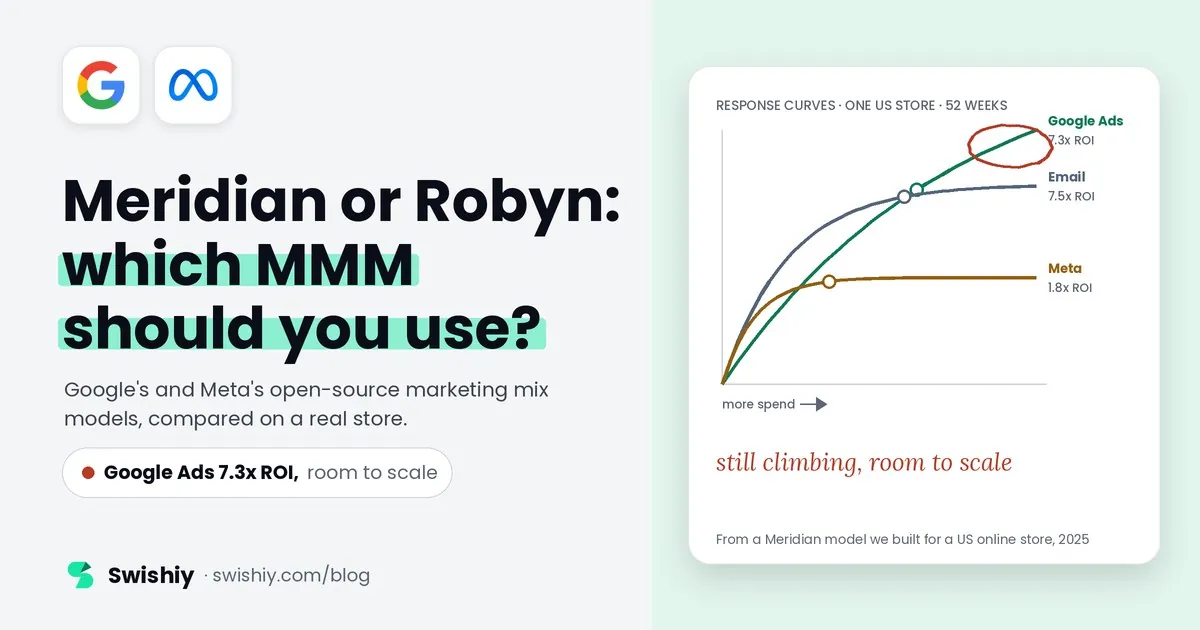
Ad platforms each report their own sales, and together they claim more than you sold. A marketing mix model answers a different question: what did each channel add? Google and Meta have both released free, open-source models, Meridian and Robyn. In a Meridian model we built for a US online store, email and Google Ads returned more than 7 times their cost, and Meta 1.8 times. The more useful finding was which of them still had room to grow. This guide compares the two tools and shows what you get out of one.
What a marketing mix model does
A marketing mix model, or MMM, looks at your history week by week: what you spent on each channel, what else was going on, and what you sold. From those patterns it estimates how much of your revenue each channel caused. It needs no cookies and no user tracking, which is why it has come back into use.
It answers questions click tracking can't. How much would you lose if you paused a channel? Where does the next $1,000 work hardest? It's also the natural check on platforms that each claim the same sale.
Meridian vs Robyn at a glance
| Meridian | Robyn | |
|---|---|---|
| Made by | Meta | |
| Language | Python 3.11 to 3.13, installed as google-meridian | R, from CRAN. A Python interface is in beta and still needs R |
| Licence | Apache 2.0 | MIT |
| Method | Bayesian model. The output is a distribution for every estimate | Ridge regression, with an evolutionary search over settings |
| What you get back | One model, with ROI and credible intervals for each channel | A set of best candidate models. The analyst picks one |
| Using experiments | Past experiment results can be set as ROI priors | Calibration with lift tests is strongly recommended |
| Geographic data | Built for geo-level data, and works on national data too | Usually run on national data |
| Extras | Reach and frequency as inputs, budget optimisation | Prophet for trend, seasonality and holidays, a budget allocator |
| Hardware | Google recommends at least 1 GPU | Runs on a normal machine with R and the Nevergrad library |
 (opens the full-size image in a new tab)
How the two methods differ
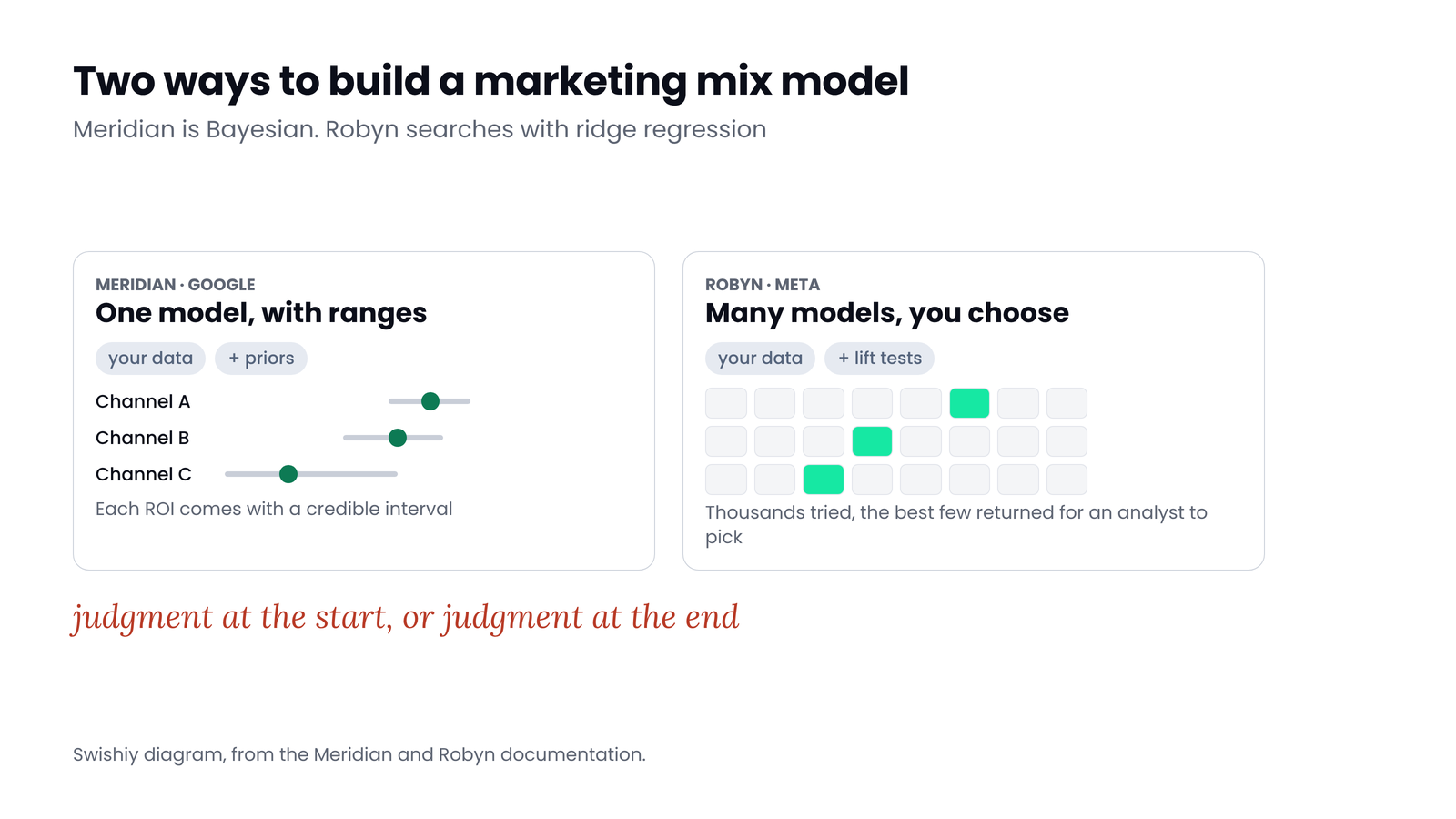
Meridian is Bayesian. You start with priors, a sensible range for each channel's return, and the model updates them with your data. Google's description is that you can "inject your existing business knowledge into the model through priors". Every result comes with a credible interval, so you can see when the model is confident and when it's guessing.
Robyn searches. It fits thousands of ridge regression models with different settings for how ads decay and saturate, and scores each on how well it predicts and how plausible its split of credit is. It then hands you the best few. Robyn's guide is clear that a person chooses between them, and that calibrating against a lift test makes that choice much safer.
Neither approach removes judgment. Meridian puts it at the start, in the priors. Robyn puts it at the end, in model selection.
How much data each one needs
Robyn's guide asks for at least two years of weekly data, and about ten observations for every variable in the model. Meridian's docs avoid a fixed minimum, and say the most reliable check is to "run the model and evaluate the width of the credible intervals". They do warn that a national model with many channels can run short of data, and suggest combining small channels or adding history.
Clean inputs matter more than the tool
What a Meridian model showed for one store
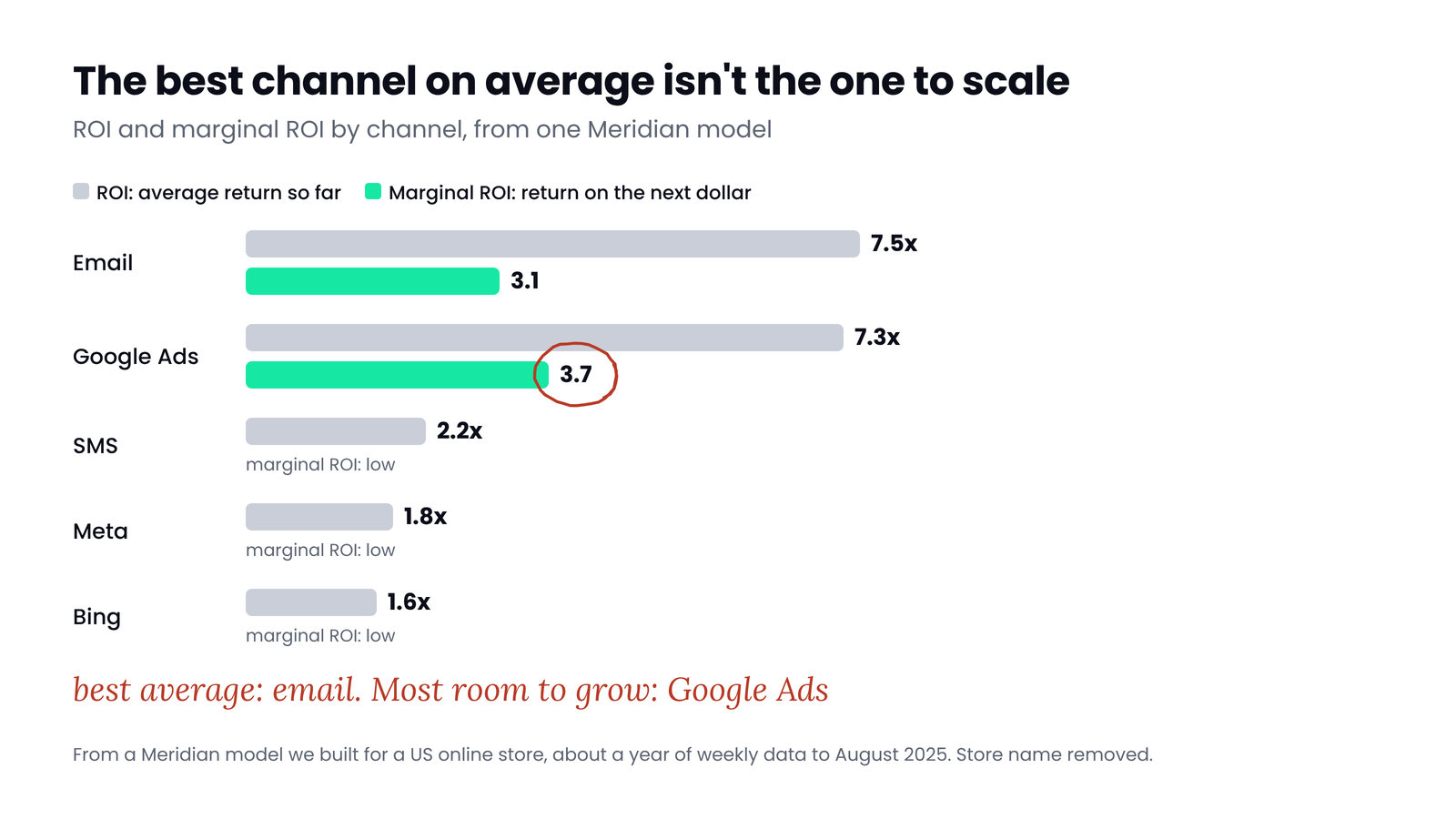
We built a Meridian model for a US online store, on about a year of weekly data across Google Ads, Meta, Bing, email and SMS. The model explained 89% of the weekly variation in revenue, and its weighted error was 11%.
| Channel | ROI | Marginal ROI | Cost per incremental $1 of revenue |
|---|---|---|---|
| 7.5x | 3.1 | $0.14 | |
| Google Ads | 7.3x | 3.7 | $0.14 |
| SMS | 2.2x | low | $0.73 |
| Meta | 1.8x | low | $0.68 |
| Bing | 1.6x | low | $0.82 |
ROI is the average return on everything spent so far. Marginal ROI is the return on the next dollar. The gap between them is the point of the exercise. Email had the best average, but its curve was flattening: more email wouldn't add much. Google Ads had almost the same average and the highest marginal return, so it was the channel with room to scale. Meta's curve flattened early.
 (opens the full-size image in a new tab)
The model also gave a range for each number. The ranges for Google Ads and email were tight. For Meta, Bing and SMS they were wide, which is the model saying it has less evidence there. A platform dashboard never tells you that.
Which one should you use?
| Your situation | Better fit | Why |
|---|---|---|
| Analyst comfortable in R, national data, want a first model soon | Robyn | Lower setup effort, and Prophet handles seasonality for you |
| Data by region or market, and someone who knows Bayesian statistics | Meridian | Geo-level data adds information, and priors hold it together |
| You run lift or geo experiments | Either | Meridian takes them as priors, Robyn as calibration |
| Lots of YouTube or video spend | Meridian | It can model reach and frequency |
| No analyst at all | Neither yet | Fix tracking first, then get help. A bad model is worse than none |
This table is practitioner judgment, ours and others', not a claim from Google or Meta. Many teams run both once and compare. If the two agree on which channels are strong, you can trust the direction.
What to question in any MMM output
- The ranges. A channel with ROI 2.0 and a range of 0.5 to 4.0 hasn't been measured yet.
- The baseline. Check how much revenue the model says would happen with no marketing, and whether that makes sense for your brand.
- Channels that move together. If you always raise Google and Meta in the same weeks, no model can separate them. Vary one at a time.
- Brand search. It often takes credit that belongs to other channels. Model brand and non-brand separately.
- The fit. Predicted revenue should track actual revenue through peaks such as Black Friday.
Myth
An MMM replaces conversion tracking.
Reality
It needs it. The model reads spend and revenue you collected, and you still need click-level tracking for bidding and for day-to-day decisions. MMM tells you how to split the budget between channels a few times a year. Tracking runs the channels in between.
Quick check
Quick check
- You have weekly spend for every channel, going back at least a year, ideally two or more.
- Your revenue series comes from orders, not from an analytics tool.
- Promotions, price changes and stock problems are recorded by week.
- Someone on the team can run and question a statistical model.
- You've decided which budget decision the model is meant to inform.
Ask yourself
A mix model is only as good as the revenue and spend it's fed. The free Tracking audit checks the numbers underneath: whether GA4 and Google Ads count each purchase once, and how GA4 revenue compares with your orders. Run my tracking audit
Frequently asked questions
What is Google Meridian?
Meridian is Google's open-source marketing mix model. It's a Python library that uses Bayesian statistics to estimate each channel's return, with credible intervals, response curves and budget recommendations. It's free to use under the Apache 2.0 licence.
What is Robyn?
Robyn is Meta's open-source marketing mix modelling package for R. It uses ridge regression and an evolutionary algorithm to test many model settings, then returns the best candidates for an analyst to choose from. It's free under the MIT licence.
Is Meridian better than Robyn?
Neither is better everywhere. Meridian handles geo-level data, priors and reach and frequency, and reports uncertainty directly, but needs more statistical skill. Robyn is quicker to set up and well documented for analysts who use R. The quality of your data matters more than the choice.
How much data do I need for a marketing mix model?
Robyn's guide asks for at least two years of weekly data. Meridian's docs give no fixed minimum and recommend judging by the width of the credible intervals, adding history or combining small channels if they're too wide.
Are Meridian and Robyn biased towards Google and Meta?
Both are open source, so the code can be inspected, and you control the data and settings. Bias is more likely to come from your inputs and priors than from the code. Running both and comparing is a reasonable check.
What's the difference between ROI and marginal ROI?
ROI is the average return on all the money spent on a channel. Marginal ROI is the return on the next dollar. A channel can have a high ROI and a low marginal ROI, which means it works but is close to saturated.
Sources
- Google for Developers: Meridian: https://developers.google.com/meridian
- Google for Developers: About Meridian: https://developers.google.com/meridian/docs/basics/about-the-project
- Google for Developers: Meridian, amount of data needed: https://developers.google.com/meridian/docs/pre-modeling/amount-data-needed
- GitHub: google/meridian: https://github.com/google/meridian
- Meta: Robyn, an analyst's guide to MMM: https://facebookexperimental.github.io/Robyn/docs/analysts-guide-to-MMM/
- GitHub: facebookexperimental/Robyn: https://github.com/facebookexperimental/Robyn
- Incubeta: Comparing Meridian and Robyn: https://insights.incubeta.com/knowledge/comparing-meridian-and-robyn

Qudees Kiani
Founder of Swishiy. Five years of marketing measurement work across Google Ads, Meta and GA4, for ecommerce and lead-gen businesses.
Book a 30-minute call
Is your Google Ads data telling the truth?
The free auditor checks tracking, brand vs non-brand and wasted spend. Automated, Google Ads only, 60 seconds.


