~90%Lower recurring cost for the server layer, and they now own it outright
Server-side tracking
They paid for a tracking server they couldn’t look inside.
WoodWatch · Seven days to replace the server every conversion ran through.
Measurement infrastructure
Your ad platforms are bidding on data that browsers keep throwing away. We move your tracking onto a server on your own domain, so Safari stops resetting your customers and ad blockers stop hiding your sales, without touching anyone's consent choice.
sGTM container, event stream
Illustrative example15%
more tracking data reaching the ad platforms · WoodWatch, last 90 days
36%
of purchase events recovered from ad blockers and browser cookie limits · same store
50+
server-side setups built on Stape
Signals lost silently3 of 5 signals arrive
Signals you control, deduplicate, and validate5 of 6 signals arrive
A server-side Google Tag Manager container, hosted on Stape and running on a subdomain of your own site, in an account you own. Your website sends one stream of events to it, and it forwards each event to the platforms you advertise on: Google Ads (with enhanced conversions), GA4, Meta Conversions API, Microsoft Advertising, TikTok Events API, Pinterest, LinkedIn and others, wherever a server endpoint exists.
Because the container runs on your domain, the cookies it sets are first-party and survive browser limits that cut ordinary tracking cookies to 7 days. Because it is yours, you can open it, see every tag, roll back any change, and take it with you if you ever change partners.
Across the setups we have built, 15 to 20% more data typically reaches the platforms once tracking runs server-side. The gain is not even across the funnel. It is largest exactly where it matters most.
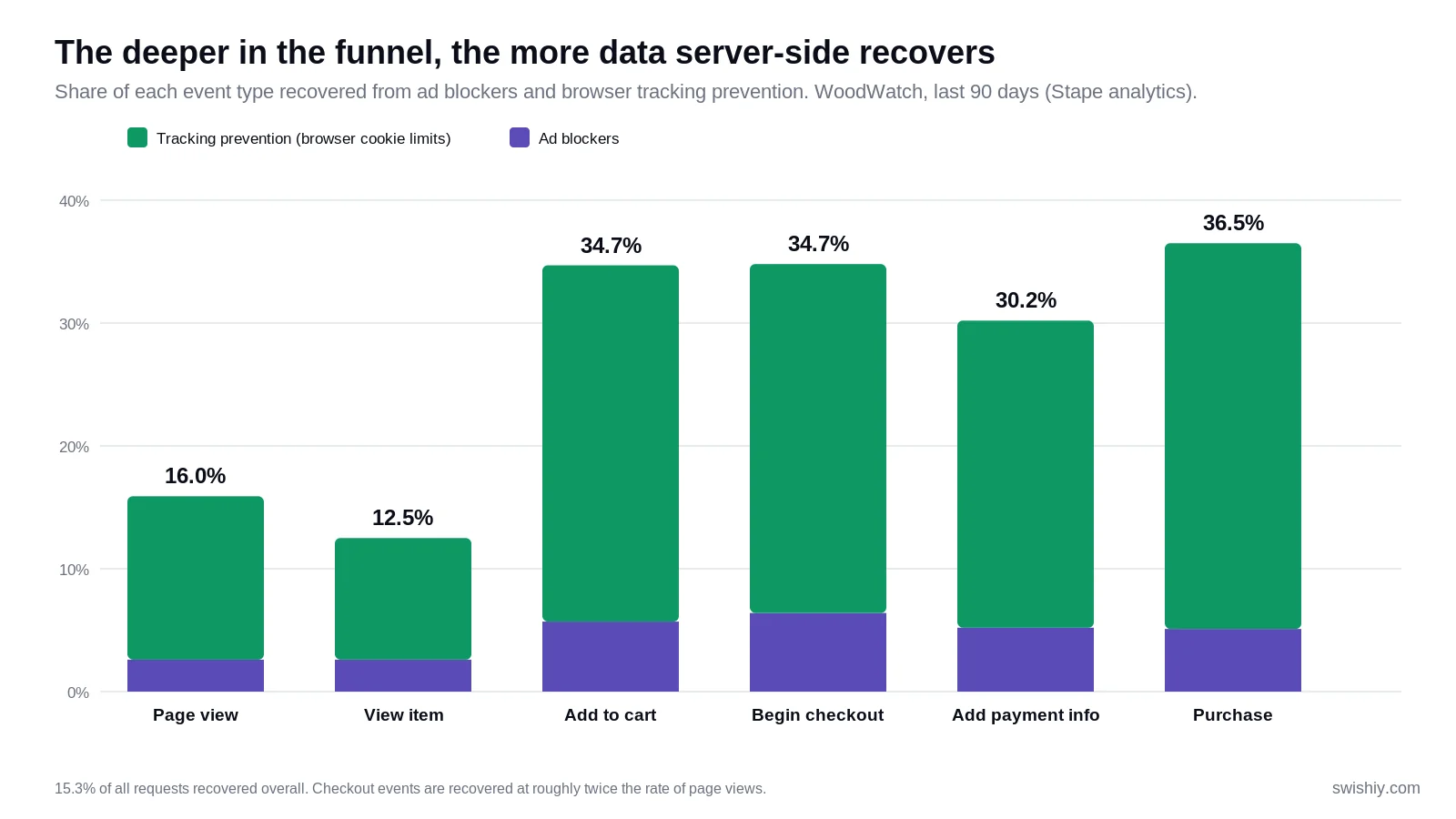
At WoodWatch, page views were recovered at 16%, but add to cart, checkout and purchase events at 30 to 37%. Buyers are more often returning visitors, and returning visitors are the ones whose cookies a browser would have quietly deleted. That is the data your ad platforms bid on.
If anyone sells you server-side tracking as a way around your cookie banner, that is a legal risk and a reason to walk away.
Which tags fire, on which pages, under which consent rules. Duplicates and dead tags are removed before anything moves.
A Stape container on a subdomain of your site, in your account, configured so the server and your site share an origin where possible.
Your website sends a single, normalized stream of events to the server instead of separate requests to every platform.
Each event forwarded to each platform, deduplicated against the browser where the platform uses both, with a shared event ID built from the order number.
Your cookie banner's choice travels with every event and the server applies it to every destination.
Purchases in every platform reconciled with your back office before sign-off, documented in a Measurement Acceptance Test.
Timeline: Typically 1 to 2 weeks from access to sign-off for a single store, up to 3 with several domains, storefronts or currencies. Most of that time is testing, not building.
Below that, there is not enough data for the recovered share to change how the platforms bid. Turn on the free native integrations your platform offers and come back later. We will tell you the same thing on a call.
Seven days from the old vendor's shutdown notice to a live server WoodWatch owns. Meta had been counting about a third of purchases twice.
~90%Lower recurring cost for the server layer, and they now own it outright
Server-side tracking
WoodWatch · Seven days to replace the server every conversion ran through.
50% → 13%Website traffic with no identifiable source, before and after
Server-side tracking
Monday Merch · 50% of their traffic had no source. One configuration field was why.
Two parts. Hosting is paid directly to Stape in your name, and scales with your traffic, from a small monthly fee for most stores. Setup is a one-off project, quoted after a short call once we know your platforms, domains and checkout. Book a call and we will give you a number, not a range.
Typically 1 to 2 weeks from access to sign-off for a single store, and up to 3 weeks with several domains, storefronts or currencies. The build takes days. Testing every event and reconciling purchases with real orders takes the rest.
Usually, and sometimes downward first. If your current setup double-counts purchases, as WoodWatch's did, reported conversions fall on go-live day while real sales stay the same. We put the expected change in writing before launch, so nobody mistakes a correction for a breakage.
Yes. The container sits in your Google Tag Manager account, the hosting is billed to your company, and the subdomain is yours. If you stop working with us, everything keeps running and stays fully readable by whoever comes next.
It can be, when consent is handled properly. We carry your cookie banner's choice into the server and apply it to every platform, so declined visitors stay declined. Server-side tracking changes where data is processed, not whether you are allowed to collect it.
Yes, along with Lightspeed, WooCommerce, custom builds and lead generation sites. On Shopify we typically keep the native integrations in place where they help and route the rest through the server, so nothing is double-counted.

Server-side tracking recovered 15% of lost data in one store we audited, and 36% of purchases. What it fixes, what it can't, and when it's worth paying for.
· 12 min read

Meta CAPI sends purchases from your server so iOS and ad blockers stop hiding them. When you need it, how to check dedup and EMQ, and what usually breaks.
· 11 min read

What server-side tracking really costs each month, using request volumes from stores we set up. Stape, Addingwell and Google Cloud compared.
· 9 min read