Google Ads Negative Keywords: A List That Won't Block Your Buyers

Qudees Kiani, founder · · 8 min read
Short answer
Negative keywords stop your ads showing for searches that contain them. Use phrase match for a word that carries the problem and exact match for one search. Since 2024 they also block misspellings, but not plurals or synonyms. Before applying any list, check each word against the searches that converted for you. A blocked buyer leaves no trace.
On this page
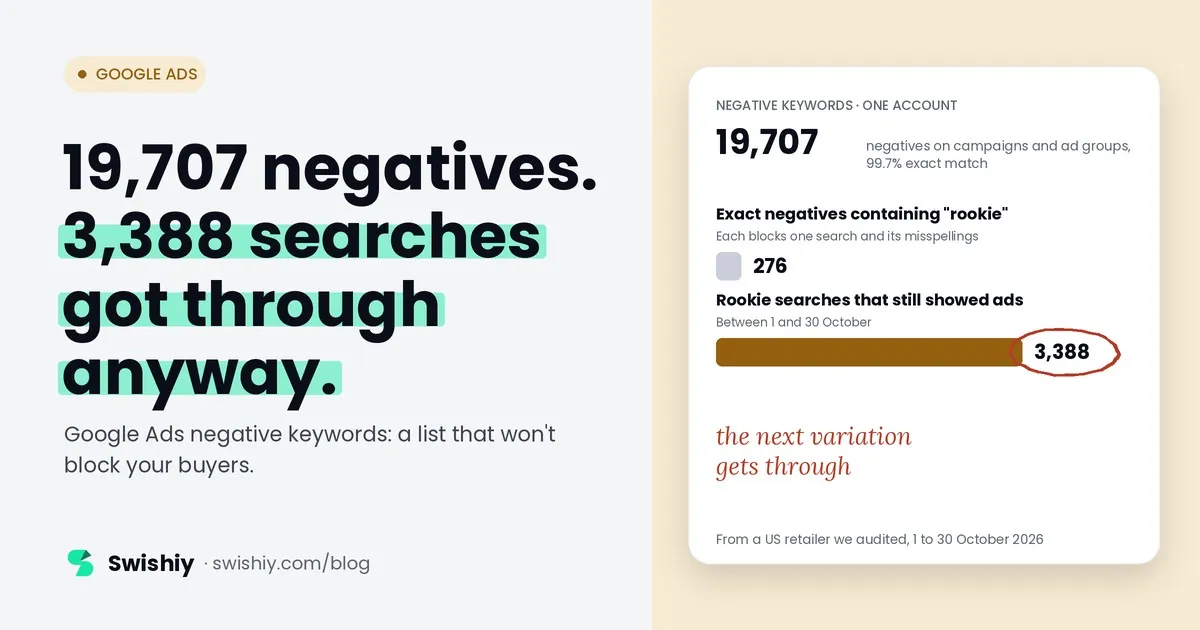
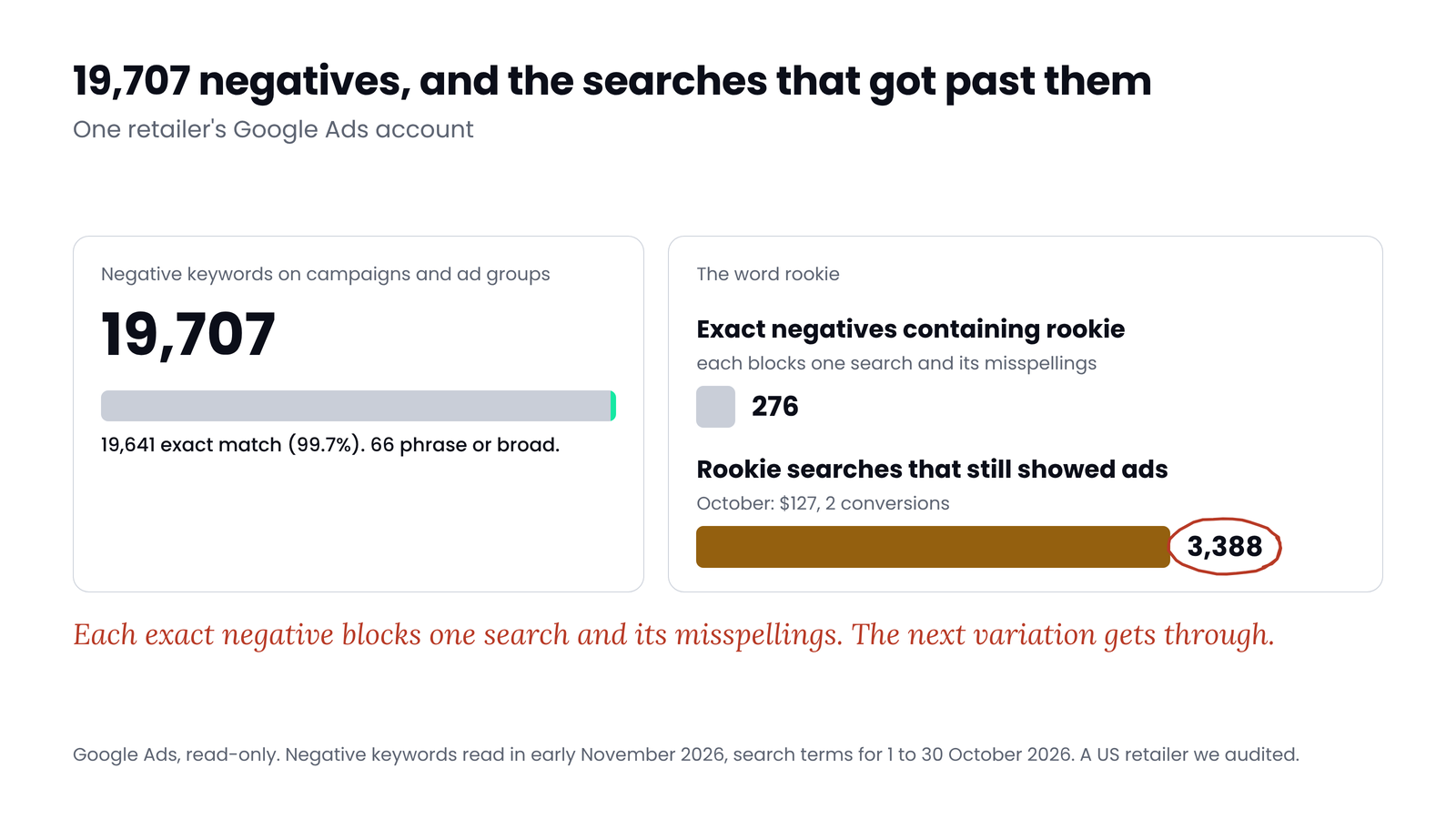
A negative keyword list copied from a blog can block your best customers, and you'll never see it happen: a search your ad didn't show for leaves no row in your search terms report. The opposite mistake is just as common. A US retailer we audited had 19,707 negative keywords on its campaigns and ad groups, 99.7% of them exact match, and between 1 and 30 October 3,388 different searches containing "rookie" still reached its ads. This guide covers how negatives match in 2026, what to exclude for your kind of business, what never to exclude, and how to check a list before you apply it.
How negative keywords match
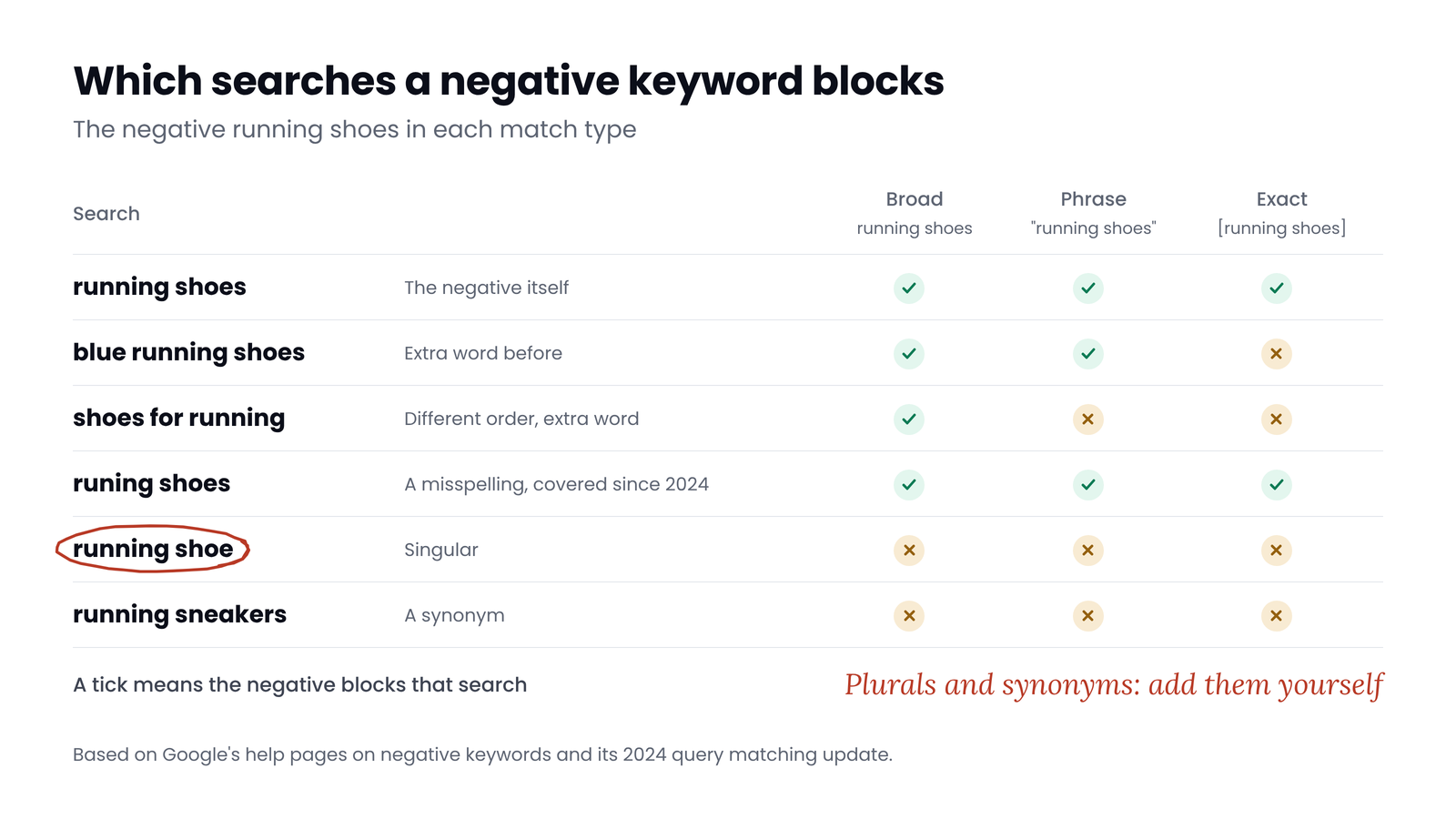
Negative keywords work differently from the keywords you bid on. They don't expand to close variants, and broad is the default match type. Here is how each type treats the negative running shoes, based on Google's example and rules:
 (opens the full-size image in a new tab)
- Broad negative: blocks any search that contains all the words, in any order. A one-word broad negative blocks every search containing that word.
- Phrase negative: blocks searches that contain the words in that order, with extra words allowed.
- Exact negative: blocks that exact search, with no extra words.
- Misspellings are covered. Since June 2024, negatives also block misspellings, for every match type. Google's Ads Liaison gave the example that a negative for loan would block lian, laon and lean. Lean is a real word, so a short negative can now reach further than you typed.
- Plurals and synonyms aren't. Google: "You'll need to add synonyms and singular or plural versions if you want to exclude them."
- Two gotchas: a negative placed after the 16th word of a long search may not block it. And Google ignores any word with a minus sign in front of it, which is how many blog lists format them. Google's example: the negative dark -chocolate works as just dark. So -free blocks nothing, and a longer line can block more than you meant.
Where negatives live, and how far they reach
| Level | Reaches | Limit | Use it for |
|---|---|---|---|
| Ad group | That ad group | No separate limit published | Steering searches between your own ad groups |
| Campaign | That campaign. In Performance Max, its Search and Shopping inventory only | 10,000 per campaign | A problem specific to one campaign |
| Shared list | Every campaign you apply it to | 20 lists, 5,000 keywords each | Patterns several campaigns share |
| Account level | Search and Shopping inventory in Search, Performance Max, Shopping, App, Smart and Local campaigns | 1,000 | Searches no campaign should ever show for |
Account-level negatives are the most powerful and the most dangerous: one wrong word blocks buyers everywhere at once. For your own brand inside Performance Max, brand exclusions are built for the job and cover misspellings and other languages. Google says negative keywords are respected when AI Max for Search is on.
What 19,707 negatives did in one account
 (opens the full-size image in a new tab)
The retailer's account held 19,707 negatives at campaign and ad group level, and 19,641 of them were exact match, each one a single search, and most sit on its Performance Max campaign. 276 of those exact negatives contained the word rookie. Between 1 and 30 October, 3,388 different searches containing rookie still showed its ads, costing $127 for 2 conversions.
Exact negatives are a record of searches that already happened. They don't stop the next variation. If a word reliably wastes money, a phrase negative on that word blocks the whole pattern in one line. Here it doesn't, because rookie searches brought two conversions: blocking the word would cut those too. A mixed pattern needs a decision: a separate campaign, a lower bid, or the specific phrases that never sell. Our guide to the search terms report shows how to group searches by word and judge them.
Myth
The more negative keywords you add, the less you waste.
Reality
A long list of exact negatives can still miss the next thousand variations, while one wrong broad word blocks buyers you never see. Google warns: "If you use too many negative keywords, your ads might reach fewer customers."
Starter lists by business type
These are starting points from our own audits, not rules. Check every word against your converting searches before you use it.
| Business | Usually safe to exclude | Never exclude without checking |
|---|---|---|
| Online shop | jobs, careers, salary, login, customer service, returns policy | free (free shipping, gluten free), cheap, sale, review, used, wholesale |
| Lead gen services, such as law or dental | jobs, salary, course, degree, free template | free consultation, near me, cost, cheap, the profession's own name |
| Software and SaaS | jobs, crack, torrent, login, tutorial for a competitor | free trial, free plan, software, app, download, alternative |
| Local services | jobs, how to fix yourself, DIY parts | near me, emergency, cost, cheap, hire (in the UK it means rent) |
| Recruiting and staffing | free courses, salary calculators | jobs, hiring, careers, recruiter, resume |
Words that are buyer words for someone
| Word on many lists | When it's a buyer word |
|---|---|
| free | Free shipping, free returns, gluten free, fragrance free, free trial, free consultation |
| cheap, budget, discount | Affordable products, outlets, a new budget line |
| jobs, hiring | Recruiters, staffing agencies, job boards, HR software |
| hire | In the UK, renting: van hire, dress hire, car hire |
| DIY, how to | Kit sellers, hardware and craft stores, courses |
| course, training | Anyone who sells training |
| review, vs, compare | Late-stage buyers comparing options before they buy |
| used, refurbished, second hand | Refurb sellers, used dealers, resale marketplaces |
| accountant, attorney, dentist, vet | The firms that sell those services. One popular list updated in October 2026 includes all four |
The blind spot
How to check a list before you apply it
- Export 90 days of search terms that converted, including Performance Max terms.
- Test every candidate word against that export. If it appears in a converting search, it's a buyer word for you. Leave it off, or use a longer phrase that excludes only the bad meaning.
- Check it against your own keywords. A negative that matches a keyword you bid on stops that keyword. Don't rely on Google's conflict recommendation alone. Practitioners report it misses some conflicts, such as those from shared lists.
- Choose the match type on purpose: phrase for a word or phrase that carries the problem, exact for one search, broad only for multi-word combinations you're sure of.
- Add plurals and synonyms yourself. Misspellings are covered.
- Apply at the narrowest level that works: campaign before shared list, shared list before account level.
- Strip the formatting from copied lists: no minus signs, and brackets or quotes only where you mean them as match types.
- Check again a week later. Impressions and clicks should fall where you expected, and conversions shouldn't.
Quick check
Quick check
- No negative matches a search that converted in the last 90 days.
- No negative blocks one of your own keywords.
- Account-level negatives are reviewed and short.
- Phrase negatives cover patterns, exact negatives cover single searches.
- Plurals and synonyms are added where needed.
- No copied list applied without checking it word by word.
- Your own brand is kept out of Performance Max with brand exclusions, not negatives.
Ask yourself
The free Google Ads Auditor reads 90 days of your account and flags negatives that block your own keywords, words that waste money across many searches, and search terms to exclude, judged against your own cost per conversion. Read-only. Check my negative keywords
Frequently asked questions
Which match type should I use for negative keywords?
Phrase match for a word or phrase that carries the problem, such as "jobs", and exact match for one specific search you never want. Broad, the default, blocks any search containing all the words in any order, which can reach further than intended.
Do negative keywords block misspellings?
Yes, since June 2024, for every match type. They don't block plurals or synonyms, so add those yourself. Because misspellings are covered, a short negative can also block a different real word that looks like a misspelling.
How many negative keywords is too many?
There's no fixed number. Google warns that too many negatives can make your ads reach fewer customers. A long list of exact negatives is a sign the keywords or match types are too loose, and a list you've never checked against converting searches is a risk at any size.
Can I add negative keywords to Performance Max?
Yes. Campaign-level negatives, shared lists and account-level negatives all work, and they apply to Performance Max's Search and Shopping inventory only. For your own brand, use brand exclusions.
Can I see which searches my negative keywords blocked?
No. A blocked search never triggers your ad, so it doesn't appear in the search terms report. That's why every negative should be checked against the searches that converted before you add it.
What is the difference between account-level negatives and a shared list?
Account-level negatives, up to 1,000, apply automatically to Search and Shopping inventory in Search, Performance Max, Shopping, App, Smart and Local campaigns. A shared list, up to 5,000 keywords, only applies to the campaigns you attach it to, so it's the safer choice for most patterns.
Sources
- Google Ads Help: About negative keywords: https://support.google.com/google-ads/answer/2453972
- Google Ads Help: Negative keywords in expert mode: https://support.google.com/google-ads/answer/12437241
- Google Ads Help: Query matching updates (2024): https://support.google.com/google-ads/answer/15070437
- Google Ads Help: Account-level negative keywords: https://support.google.com/google-ads/answer/11396330
- Google Ads Help: Account limits: https://support.google.com/google-ads/answer/6372658
- Google Ads Help: Add negative keywords to campaigns: https://support.google.com/google-ads/answer/7102995
- Google Ads Help: About brand settings for Search and Performance Max: https://support.google.com/google-ads/answer/13721847
- Google Ads Help: Negative keywords in Performance Max: https://support.google.com/google-ads/answer/15726455
- Google Ads Help: AI Max for Search: https://support.google.com/google-ads/answer/15913066
- Google Ads Help: Auto-applied recommendation types: https://support.google.com/google-ads/answer/10279006
- Search Engine Roundtable: Negatives and misspellings (2024): https://www.seroundtable.com/google-ads-changes-query-matching-brand-controls-37634.html
- One PPC: Negative keyword list (example of a published list): https://oneppcagency.co.uk/google-ads/negative-keyword-list/

Qudees Kiani
Founder of Swishiy. Five years of marketing measurement work across Google Ads, Meta and GA4, for ecommerce and lead-gen businesses.
Book a 30-minute callIs your Google Ads data telling the truth?
The free auditor checks tracking, brand vs non-brand and wasted spend. Automated, Google Ads only, 60 seconds.